
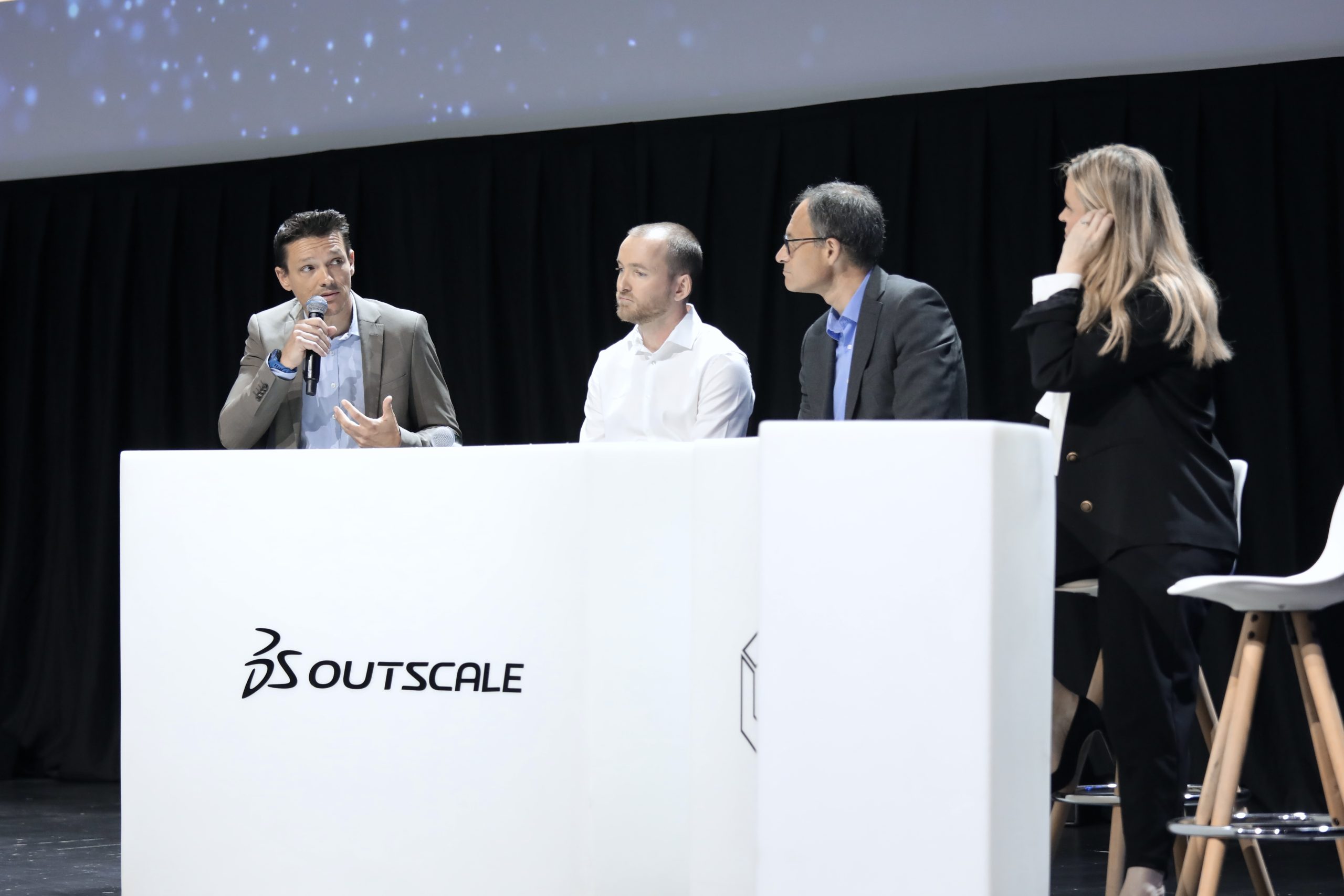
As part of OUTSCALE EXPERIENCES, this plenary session highlighted a major transformation led by the French Directorate General of Customs and Indirect Taxes (DGDDI). Undertaking a complete overhaul of its customs code from 500 to 1,200 articles, the institution had to support a rapid upskilling of its agents, who were faced with significant regulatory changes.
To address this operational challenge, the DGDDI deployed a natural language artificial intelligence assistant, accessible on mobile devices, to facilitate the application of the new rules in the field.
On this occasion, Jérôme Sandrini, CRO at OUTSCALE, Éric Laurent, Head of the “IT Support” Office at DGDDI, and Quentin Lebourgeois, Public Sector AI Services Lead at Sopra Steria, shared their feedback and perspectives on this project.
Challenges and Issues
After several pilot experiments starting in 2024, the DGDDI launched an industrialization phase in 2025 with the goal of a full-scale rollout by May 1, 2026.
Strategic Requirements and Priorities
From an operational standpoint, the tool needed sufficient performance and robustness to support approximately 17,800 users, while remaining flexible enough to adapt to evolving usage and regulatory changes. Given these security and compliance constraints, the administration opted for a sovereign architecture based on open source, using the UGAP procurement channel.
Systems and Infrastructure Implemented
The solution relied on close collaboration between three key entities: the DGDDI, which defined business needs; Sopra Steria, responsible for technical integration and software design; and OUTSCALE, which provided hosting on a sovereign SecNumCloud-certified Cloud infrastructure, ensuring computing power (GPU), flexibility, and rapid deployment.
To enable fast rollout and efficient scaling without heavy hardware investment, OUTSCALE provided an industrialized Cloud infrastructure optimized for GPU resources.
Jérôme Sandrini, Chief Revenue Officer at OUTSCALE, emphasized that for any large-scale AI project, Cloud usage becomes essential. OUTSCALE delivers “this elasticity combined with security and the well-known SecNumCloud certification.” He also highlighted the critical role of a partner ecosystem in accelerating time-to-market and enabling large-scale integration of new services.
Acting as the bridge between technical infrastructure and operational needs, Sopra Steria industrialized all components: conversational interfaces, ingestion pipelines, retrieval-augmented generation (RAG), and vectorization. To ensure security and operability while preventing “shadow AI,” the company integrated the solution into the information system, including directory services, authentication, and the SOC.
According to Quentin Lebourgeois, Head of AI for Public Services at Sopra Steria, “the use of managed sovereign solutions made it possible to build a response tailored to business challenges while avoiding the complexities of infrastructure management.”
According to the DGDDI, the project’s success was based on several strategic pillars: strong executive support, clear prioritization of needs with security and sovereignty at the forefront, and a pragmatic approach informed by past experience. To facilitate industrialization, deployment began with a simplified use case. As Éric Laurent, Head of the “IT Support” Office at the DGDDI, noted, “the operational goal was to provide agents with a natural language assistant directly accessible on their mobile devices during their daily operations.”
Key Takeaways
- The value of generative AI lies in its ability to address immediate business needs. By focusing on regulatory support for field agents, the DGDDI removed a major operational bottleneck, enabling agile integration and organization-wide adoption.
- The project’s success relied on a demanding technical foundation: the use of a SecNumCloud-certified Cloud, open-source technologies, and strict adherence to sovereignty criteria such as local hosting, reversibility, and interoperability with the information system. This strategy ensured a balance between technological progress and regulatory compliance.
- The success of this large-scale deployment was driven by the complementarity of a strategic trio: deep understanding of business challenges, tailored technical integration, and scalable infrastructure. This close collaboration between the DGDDI, Sopra Steria, and OUTSCALE enabled rapid service expansion while maintaining a high level of security.
