
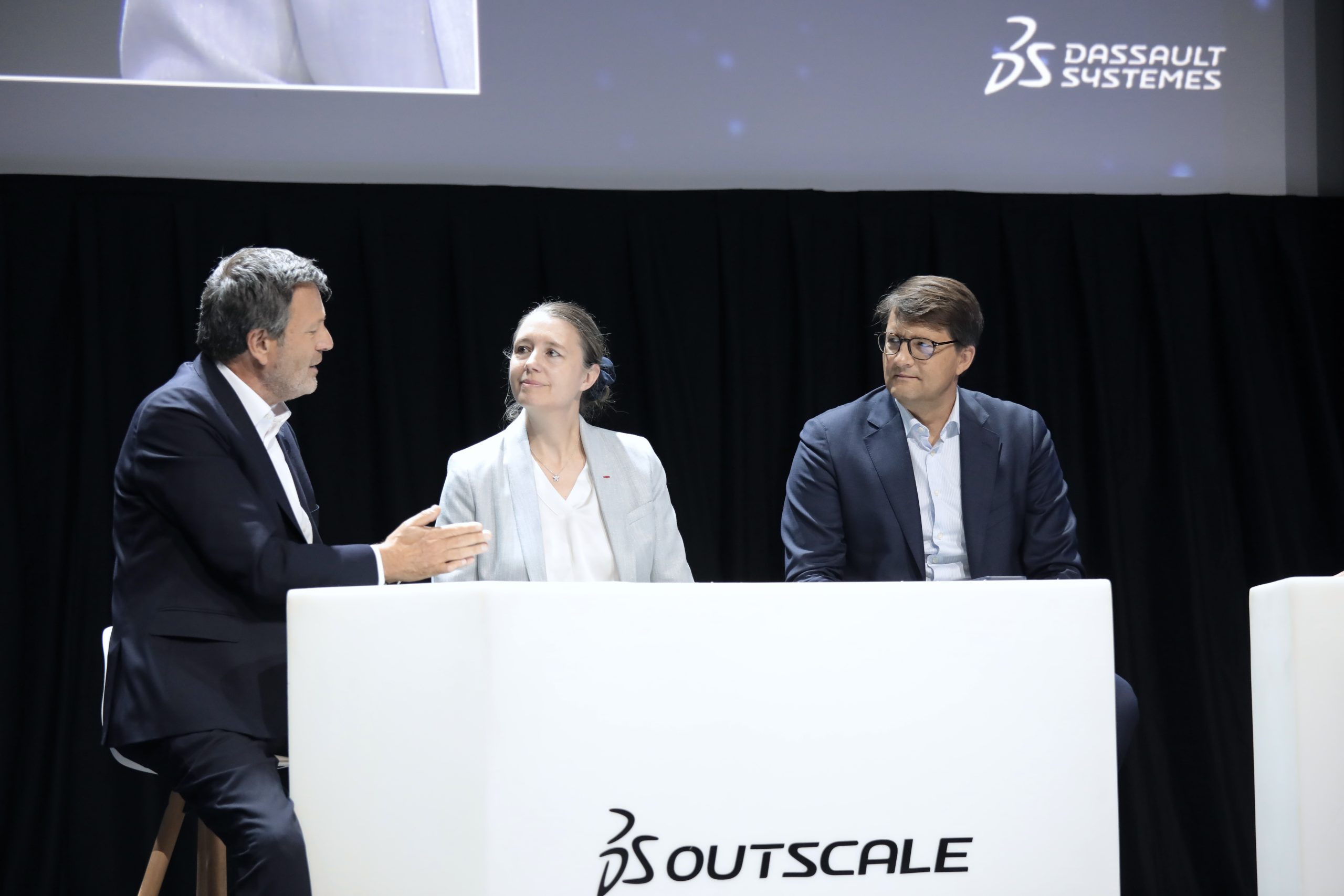
The question is no longer whether sovereign collaborative solutions should be adopted, but rather how to deploy them concretely at scale. This was precisely the focus at OUTSCALE Experiences 2026, during a roundtable featuring Stéphanie Schaer (former head of DINUM), Jean-Pierre Lach (CEO of Private Discuss) and Philippe Miltin (CEO of OUTSCALE).
The DINUM suite: 500,000 users and a three-part solution stack
For several years, DINUM has coordinated a catalog of interministerial collaborative resources for French civil servants. The operational continuity of public services now relies on three major technological pillars:
- Tchap: secure messaging with more than 800,000 accounts, including half a million active users.
- Visio: a trusted videoconferencing solution whose full rollout across all ministries was approved in early 2026.
- France Transfert: a platform dedicated to secure document sharing.
These solutions prioritize interoperability and open standards, such as the Matrix protocol used by Tchap. They are hosted on infrastructures certified SecNumCloud by ANSSI, ensuring optimal protection for sensitive government data.
“Controlling our videoconferencing tool is critical because it is the central lever in crisis management. Its accessibility must be guaranteed at all times and across the entire territory.” – Stéphanie Schaer, Former Interministerial Director for Digital Affairs (DINUM)
A robust and structured security architecture
For Stéphanie Schaer, the resilience of government digital solutions is no accident. DINUM deploys a cybersecurity strategy structured in multiple layers, built on rigorous organization.
The pillars of continuous protection
Security is approached as a dynamic and ongoing process. This framework relies on essential foundations to ensure system integrity:
- Compliance and certification: regular audits and approvals based on ANSSI standards;
- Ethical hacking: bug bounty programs across all tools developed by DINUM;
- Monitoring and response: a dedicated CSIRT for event log analysis and incident handling;
- Continuous improvement: systematic post-incident feedback analysis.
The regulatory framework, reinforced by the SREN law, now requires entities handling sensitive data to use SecNumCloud-certified hosting. In this respect, OUTSCALE provides a fully compliant solution.
Sovereignty ≠ loss of productivity
Jean-Pierre Lach, CEO of Private Discuss, immediately dismissed a persistent misconception: that sovereignty undermines efficiency.
“No one questions the productivity loss of locking their headquarters or implementing access control at the office entrance. It is essentially the same idea.” – Jean-Pierre Lach, CEO of Private Discuss
To compete with American standards (Teams, Zoom, WhatsApp), Private Discuss has opted for total rigor: equivalent functional coverage, user experience on par with market leaders, full end-to-end code control, and even white-label capabilities for large enterprises wishing to integrate the solution into their brand identity.
Among its clients: EDF, which won a European tender open to all collaboration providers, with a clear strategy to secure 10% of its sensitive communications. Also Enedis and Fram.
The most critical use cases
- Private webinars in the defense sector for pre-sales on confidential R&D topics
- Multi-company collaboration on sensitive defense projects
- Business continuity plans in case of a “kill switch”: preconfigured crisis rooms activated within minutes
- Protection of the decision-making process, not just documents but also the exchanges surrounding their creation
- Compliance with extraterritorial laws: using an uncontrolled tool can effectively serve as evidence of non-compliance in a U.S. court
The role of infrastructure: SecNumCloud and AI
Philippe Miltin emphasized that without certified infrastructure, even the best collaborative applications lose their value. OUTSCALE’s SecNumCloud qualification is the foundation supporting solutions from DINUM and Private Discuss.
Beyond pure security, AI integration is emerging as the key differentiator. Automatic transcription, meeting summaries, real-time assistance during videoconferences: these features are becoming expectations rather than options. Delivering them at scale—hundreds of thousands of users on the public sector side, tens of thousands in critical industries—requires sovereign GPU capabilities.
“AI in videoconferencing is now an absolutely essential feature.” – Philippe Miltin, CEO, OUTSCALE
OUTSCALE also supports its partner ecosystem: Jamespot, Interstis, Hexagone, CollabNext, and hosts Swym, the collaborative tool integrated into Dassault Systèmes’ 3DEXPERIENCE platform, used by 400,000 clients.
Towards European digital commons
The European dimension may be the most structurally significant ambition in the long term. DINUM is working to build a European alliance around digital commons, materialized through the creation of an EDIC (European Digital Infrastructure Consortium). Founding countries include France, Germany, the Netherlands, Italy, and Luxembourg, later joined by Poland and Denmark.
The goal is to pool public and private investment at the European level to develop sovereign alternatives across all technological layers (messaging, cloud, AI, cybersecurity), relying on open standards such as Matrix, OpenID, and Kubernetes.
This momentum is now officially recognized: the European Commission recently published its open-source strategy, identifying digital commons as a key lever of sovereignty.
Key Takeaways
The OUTSCALE Experiences 2026 roundtable demonstrated this clearly: sovereign collaborative solutions are no longer limited to pioneering public administrations. They are now used by hundreds of thousands of public sector employees, major listed industrial groups, and defense players, with performance and user experience levels that rival non-European providers.
The combination of SecNumCloud-certified infrastructure, applications built on open standards, and growing AI integration is shaping a mature sovereign ecosystem capable of scaling. The ongoing European momentum could, in the coming years, turn it into a model exportable well beyond French borders.
