
Mastering the carbon footprint of Cloud has become a central challenge for organizations deploying applications, virtual machines, GPU services, and large-scale storage capacities. Available since November 2025, OUTSCALE’s My Carbon Footprint provides structured visibility into the estimated carbon impact of Cloud usage within a sovereign and secure environment. This tool helps companies understand their emissions, meet certain reporting requirements, and steer their decisions toward more resource-efficient Cloud practices.
The digital carbon footprint and the rise of data centers
Digital technologies now account for a significant share of the carbon footprint, both in France and globally. This footprint is growing due to the widespread adoption of SaaS applications, generative AI, high-performance computing, and the continuous increase in data volumes.
Data centers play an increasingly important role in this equation. Their share of digital impact has risen sharply since 2022. This trend is driven by intensifying computing and storage needs, as well as the development of particularly demanding use cases, notably GPU infrastructures dedicated to language models and AI workloads.
Forecasts point to a very significant increase in data center electricity consumption by 2030. AI usage contributes to this trend, even as precise assessments of its environmental impact continue to evolve. Organizations must therefore integrate energy efficiency, resource sizing, and infrastructure choices from the outset of their digital projects.
Public Cloud as a lever for environmental efficiency
Using public Cloud infrastructure is a first lever for controlling environmental impact. Resource pooling enables higher server density, more efficient equipment utilization, and continuous optimization of workloads.
This efficiency also relies on Cloud-specific mechanisms such as dynamic capacity adjustment, automatic scaling, and reduction of unused resources. A properly sized infrastructure limits overcapacity and promotes consumption better aligned with applications’ actual needs.
The location of data centers also plays a decisive role. In France, the electricity mix has a particularly favorable carbon intensity, around 40 grams of CO₂ per kWh. Deploying Cloud workloads in a region with largely decarbonized electricity directly improves the estimated carbon footprint of digital usage.
Data center efficiency is also measured through operational indicators such as PUE (Power Usage Effectiveness) for energy efficiency and WUE (Water Usage Effectiveness) for water efficiency. Public Cloud infrastructures can achieve better results thanks to their level of industrialization, equipment pooling, and adapted cooling technologies.
Data centers designed for a more sustainable cloud infrastructure
The sustainability of a Cloud service depends as much on the technology provided as on data center operators’ practices. The infrastructures used by OUTSCALE in France rely on ISO 50001 certification for energy management and ISO 14001 for environmental management. They are also aligned with the European Code of Conduct for Data Centers.
Renewable electricity supply via guarantees of origin is an important element of this approach. Cooling systems also contribute to sites’ environmental performance. Technologies used include free cooling, free chilling, hybrid solutions with adiabatic cooling, and, in some rooms, direct liquid cooling.
Reducing environmental footprint also involves careful lifecycle management of equipment. Extending usage duration, reusing, and recycling are major focus areas. This issue is particularly sensitive for GPUs, whose replacement cycle can be faster than CPUs due to evolving AI-related needs.
Choosing the right GPU model must therefore respond to a clearly identified business need. Sizing adapted to language models, processing volumes, and performance objectives helps limit unused resources and control associated impacts.
My Carbon Footprint: measuring the carbon impact of Cloud usage
My Carbon Footprint addresses a concrete need for visibility into the carbon footprint of Cloud resources used on the OUTSCALE infrastructure. The tool provides data to track the estimated impact of usage, feed reporting efforts, and support operational decision-making.
Three use cases particularly structure the value of this feature:
- Track the estimated carbon footprint of Cloud resources used on the OUTSCALE infrastructure.
- Have useful data to meet requirements such as CSRD or greenhouse gas inventories.
- Understand the main impact drivers related to virtual machines, GPUs, and storage.
The tool is accessible from the OUTSCALE Cockpit, under My Data then My Carbon Footprint. API access is also available, facilitating the integration of carbon data into internal dashboards, CSR initiatives, or reporting processes.
Users can select their main Cloud account or sub-Cloud accounts to analyze different environments. The available history covers up to 36 months, starting from January 2024. Results can be displayed in tonnes of CO₂ equivalent or kilograms of CO₂ equivalent, depending on the required level of granularity.
Detailed breakdown by service and emission source
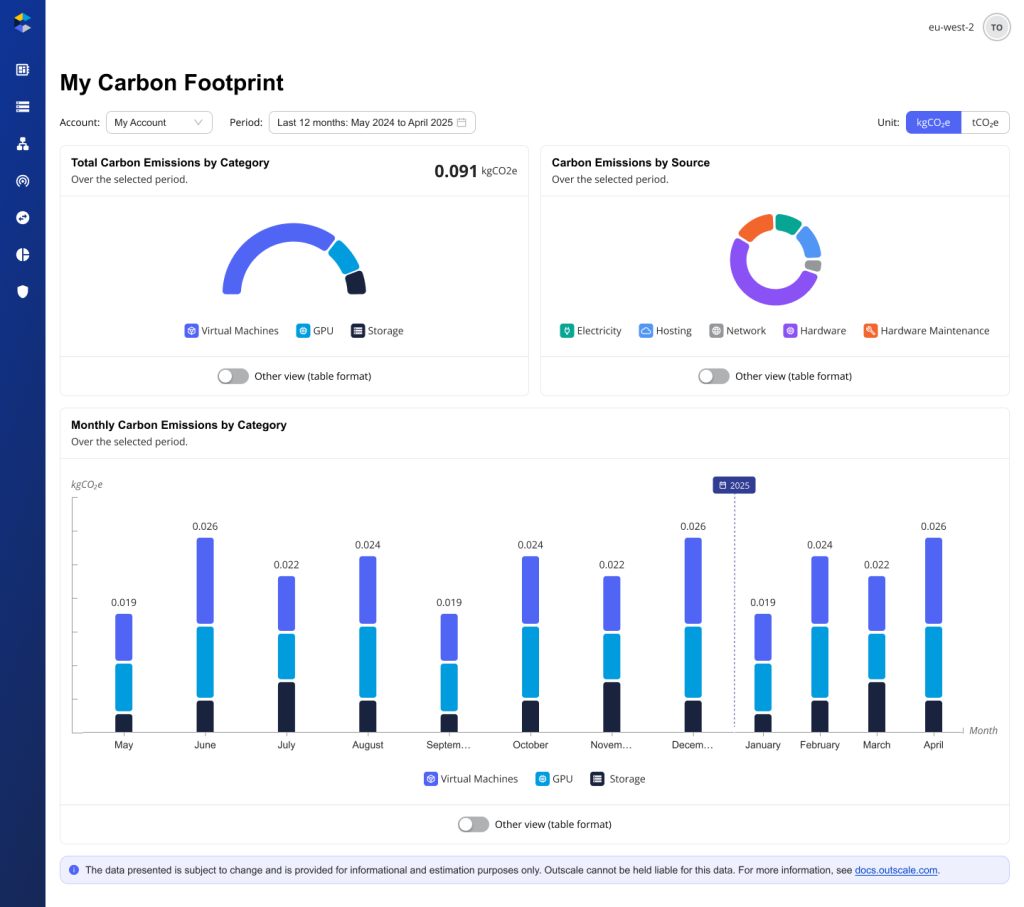
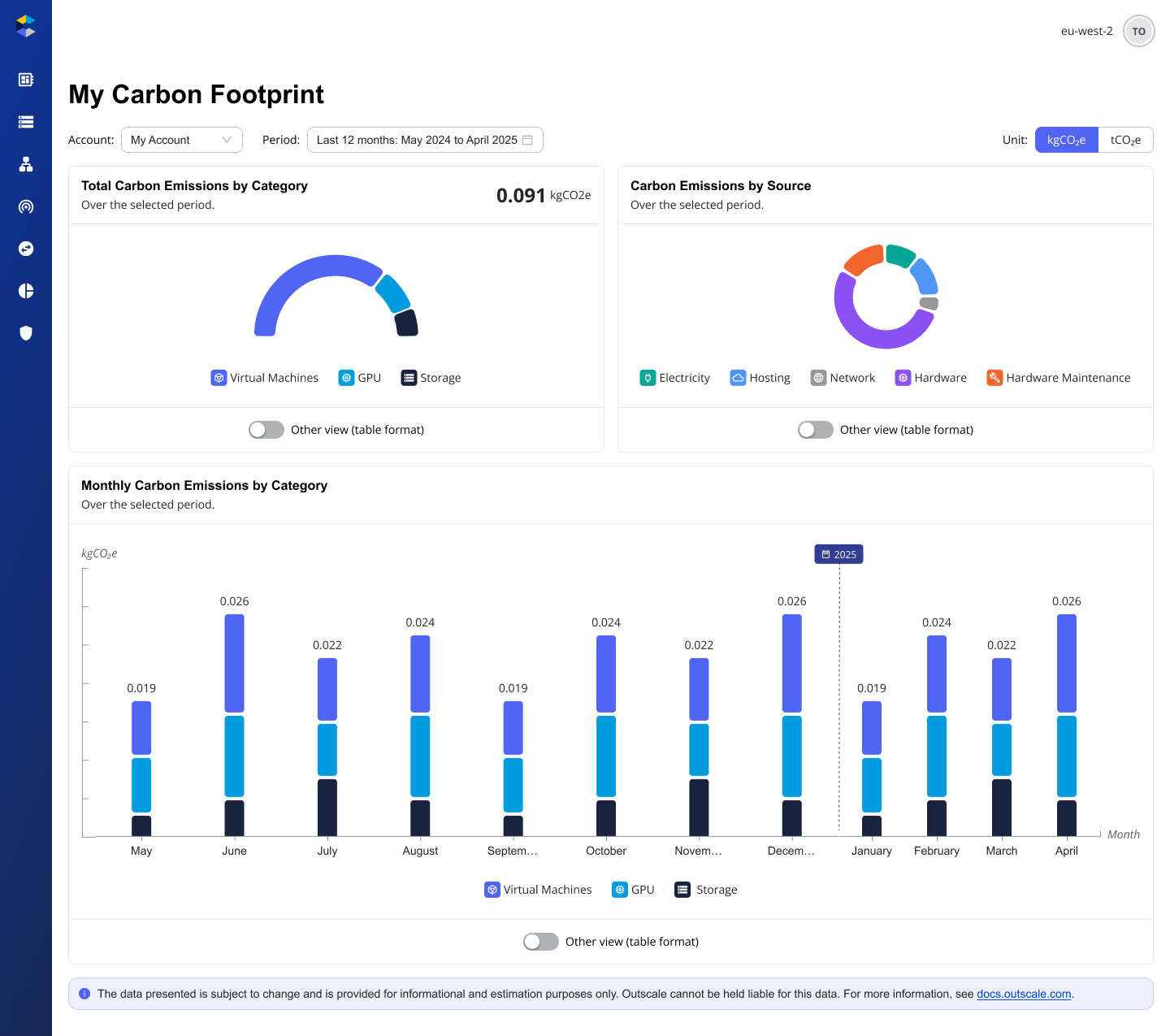
My Carbon Footprint provides a breakdown of the carbon footprint by service type. This analysis distinguishes virtual machines, GPUs, and storage, making it easier to identify the biggest contributors. Interactive visualizations provide access to absolute values and ratios associated with each resource category.
The tool also offers a view by emission source. This view covers several components of the environmental footprint:
- Electricity consumed by the infrastructure.
- Hardware mobilized.
- Network.
- Hosting and maintenance of data center equipment.
Data can be displayed as charts or tables. This flexibility improves information accessibility for technical teams, CSR managers, finance departments, and compliance teams.
A monthly breakdown by service also makes it possible to observe changes over time. The projection presented is based on the last 24 months, providing a useful basis for tracking trends, analyzing consumption variations, and identifying periods requiring resource adjustments.
A documented and traceable carbon methodology
Measuring the digital carbon footprint relies on methodologies that continue to evolve. Several frameworks coexist, employing different scopes, assumptions, and calculation factors. Interpreting results therefore requires particular attention to the method used.
My Carbon Footprint is built on three guiding principles: pragmatism, transparency, and scalability. Pragmatism aims to provide actionable data to manage Cloud usage and guide decisions. Transparency involves clarifying methodological choices, elements taken into account, and calculation scope limits. Scalability allows the method and proposed features to be progressively enriched.
The first version of My Carbon Footprint covers the European region. The ambition is to gradually extend the scope to other regions, integrate new services, and refine data granularity. This trajectory supports increasingly precise environmental management of Cloud infrastructures.
Toward responsible cloud management
Reducing the Cloud carbon footprint relies on a combination of technological, operational, and organizational choices. Using efficient infrastructure, selecting committed data centers, optimizing resources, and regularly measuring impacts are complementary practices.
My Carbon Footprint transforms environmental data into a concrete management tool. By visualizing the estimated impact of virtual machines, GPUs, and storage, organizations have a stronger basis for adjusting their architectures, limiting over-sizing, and embedding their Cloud usage in a responsible digital approach.
